
PART RECOVERY
Interfaces

Interfaces in the recovery process

Part Recovery is a cross-functional project.

An unavailable part rarely affects only one department.

It affects availability, engineering, quality, approval, operations, maintenance, procurement and lifecycle management.

A recovery project therefore does not start with the question:

Can someone manufacture this part?

But with the question:

Who needs to be involved so that the part can reliably be returned to operation?

Start Recovery Assessment →

Why interfaces are decisive

An obsolete part is usually not an isolated parts problem.

It is an availability risk.

To make a recovery case workable, several perspectives must be aligned early:

  • What is the impact of the missing part on operation or availability?
  • Which function must be technically restored?
  • Which data, samples or drawings are available?
  • Which evidence is required?
  • Who is allowed to approve the solution?
  • When must the part be operational again?
  • How will the solution be procured and installed?

Only with this information does a robust recovery path emerge.

The roles involved

Who collaborates in a recovery case

Six perspectives without which a recovery path will not emerge.
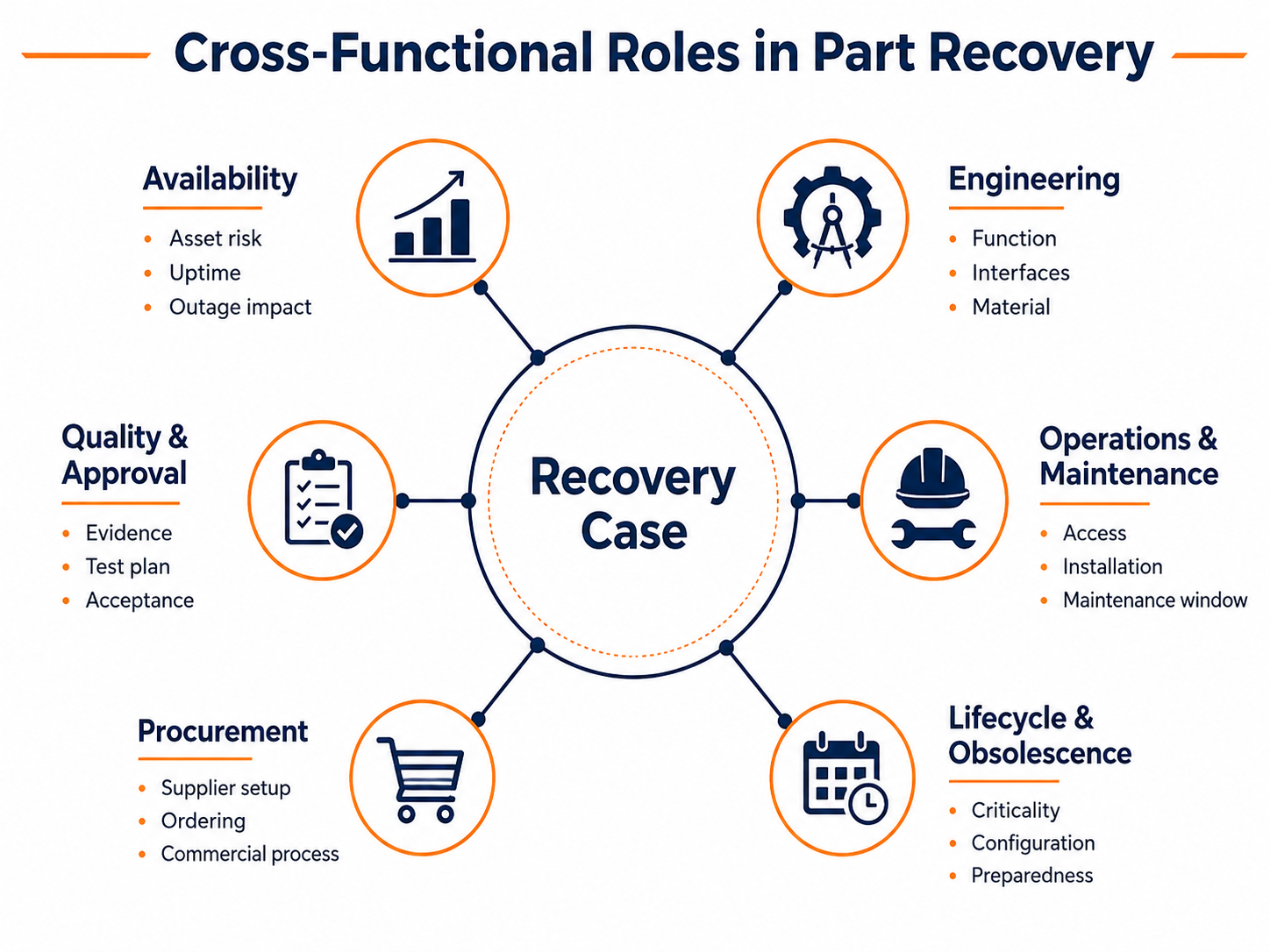
Who collaborates in a recovery case

Availability

Typical roles
  • Asset Manager
  • Fleet Manager
  • Maintenance Manager
  • Head of Maintenance
  • Technical Superintendent
  • Sustainment Manager
  • Outage Manager
  • ECM Manager
Central question

What happens if this part is not available in time?

Engineering

Typical roles
  • Engineering
  • Operations Engineer
  • Responsible Engineer
  • Design Engineer
  • Workshop Engineering
  • Welding Supervisor
  • Materials Engineer
Central question

Which function must be restored?

Typical contributions
  • function
  • interfaces
  • critical dimensions
  • material
  • operating conditions
  • wear pattern
  • repair history
  • installation context

Quality and Approval

Typical roles
  • Quality Manager
  • Certification Manager
  • Approval Engineer
  • Technical Authority
  • ECM Responsible
  • Inspection Authority
  • Classification Society
  • Certifying Body
  • Operator Approval
Central question

Which evidence is required so that the solution can be accepted?

Typical contributions
  • inspection requirements
  • material certificates
  • dimensional reports
  • NDT requirements
  • documentation obligations
  • acceptance path
  • risk assessment

Operations and Maintenance

Typical roles
  • Maintenance
  • Workshop Management
  • Depot Maintenance
  • Chief Engineer
  • Service Partner
  • Field Service
  • Docking Manager
  • Operations Management
Central question

How can the solution be implemented in practice?

Typical contributions
  • maintenance window
  • accessibility
  • installation conditions
  • downtime
  • tooling needs
  • installation sequence
  • operating experience

Procurement

Typical roles
  • Spare Parts Manager
  • Procurement
  • Strategic Buyer
  • Category Manager
  • Supplier Quality
  • Service Commercial Manager
Central question

How can the solution be ordered cleanly — contractually, commercially and through the supplier side?

Typical contributions
  • supplier onboarding
  • purchase order
  • framework contract
  • price and schedule
  • compliance
  • commercial processing

Lifecycle and Obsolescence

Typical roles
  • Obsolescence Manager
  • Lifecycle Manager
  • Product Support Manager
  • Configuration Manager
  • Spare Parts Strategy Manager
  • Fleet Engineering
Central question

Is this case part of a larger obsolescence risk?
Typical contributions
  • variant status
  • lifecycle strategy
  • critical component lists
  • recovery preparedness
  • reference samples
  • digital data
  • configuration control
  • future recurrences

The role of FIT

The role of FIT

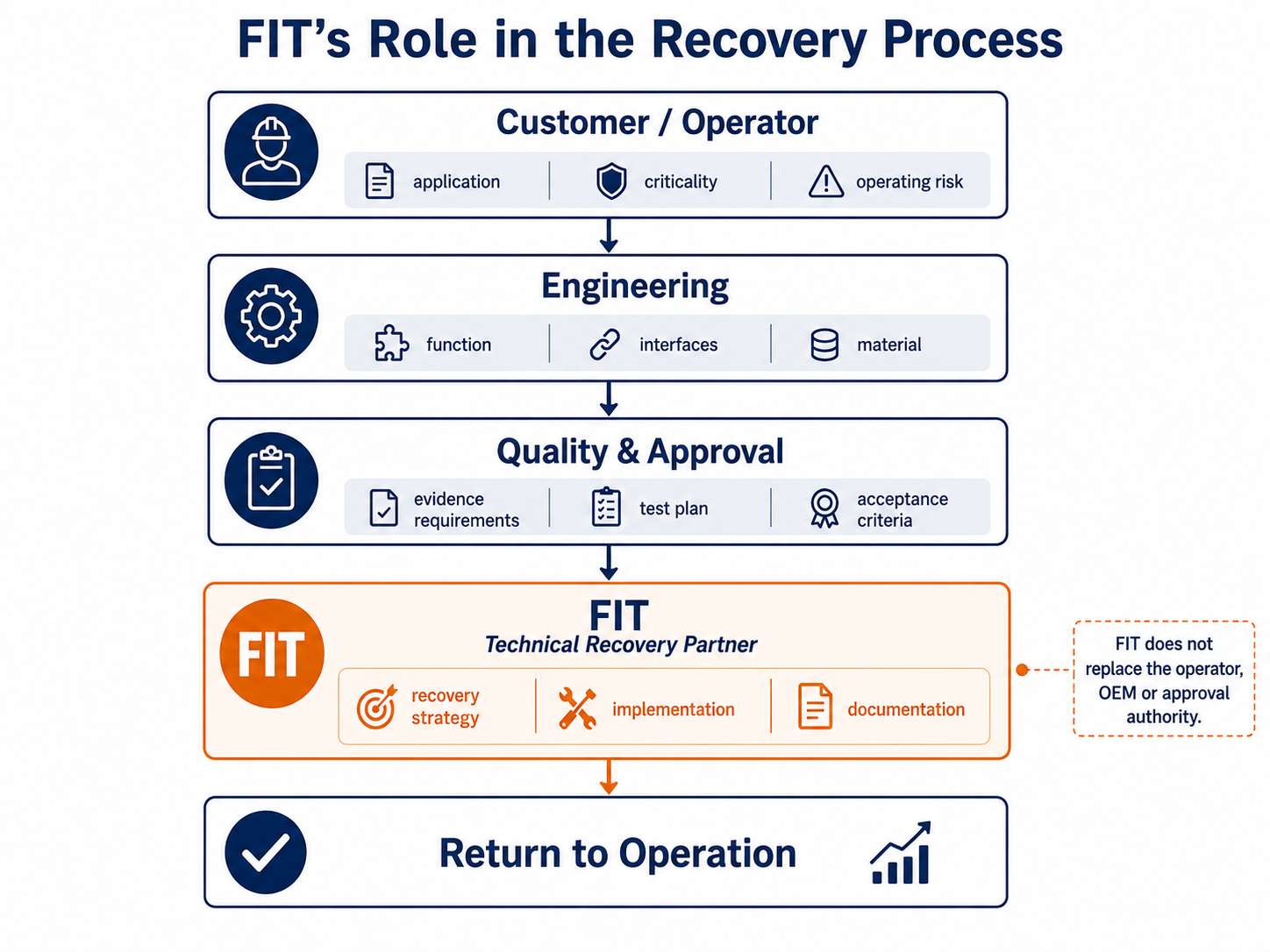
A recovery case needs clear responsibilities.

The operator knows application, criticality and operational risk.

Engineering knows function, interfaces and operating conditions.

Quality and approval define evidence and acceptance criteria.

Procurement enables the order.

In this interplay FIT takes the role of the technical recovery partner.

  • We do not replace the customer's internal responsibility.
  • We do not replace an OEM.
  • We do not replace an inspection authority.
  • We do not automatically take over the final approval.

We make the recovery case technically decidable and implementable.

What FIT concretely contributes

FIT supports where an obsolescence problem has to become a technical recovery project. This means:

  • assess existing data, samples and damage
  • work out function and critical characteristics
  • clarify material and process questions
  • derive possible recovery strategies
  • examine suited manufacturing, repair or reconstruction routes
  • prepare required evidence and testing
  • build documentation for the technical decision
  • execute the chosen recovery path

This turns an unclear request into a structured recovery case.
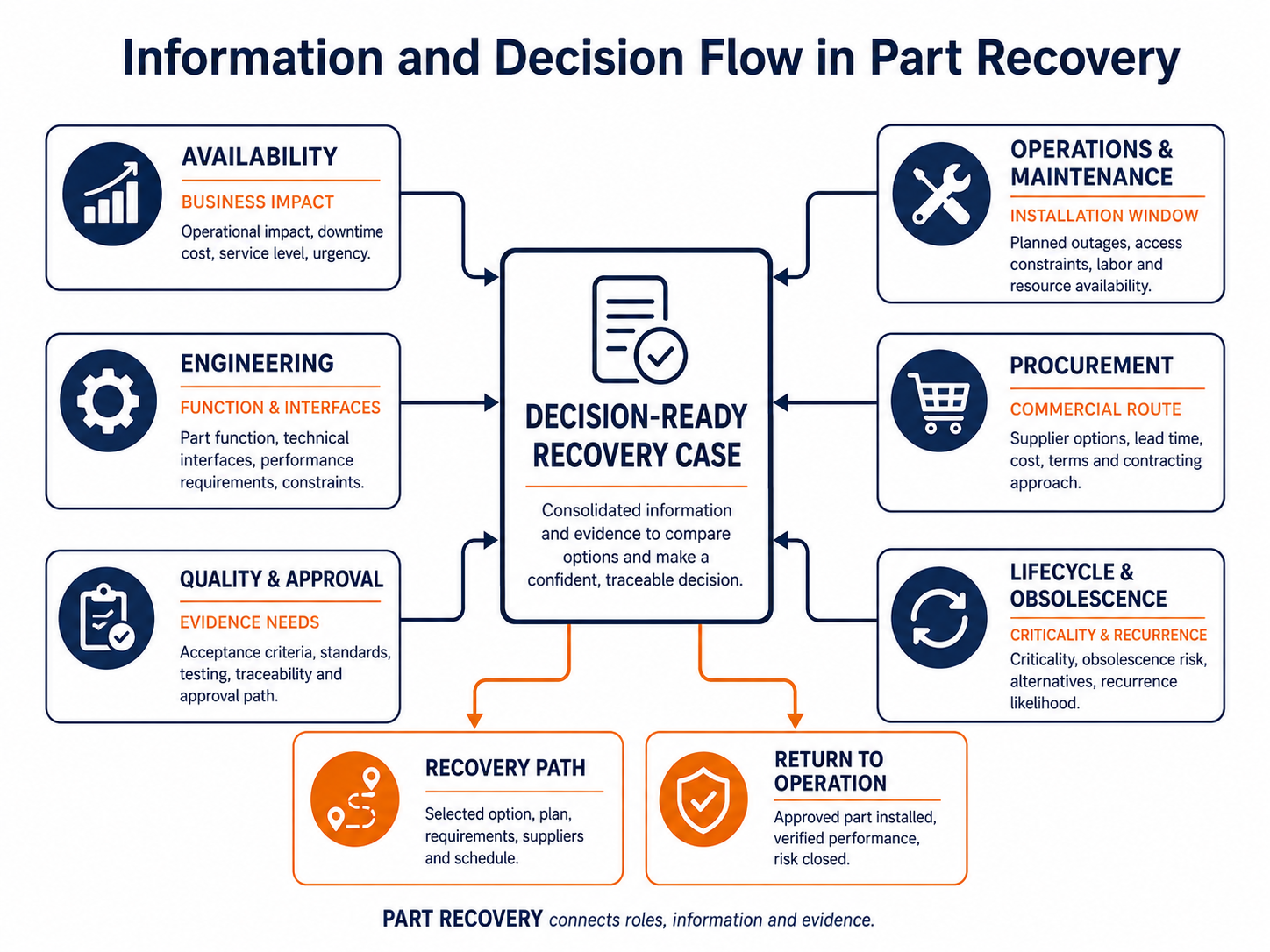
Interfaces in the Recovery Check

Interfaces in the Recovery Check

The Recovery Check therefore does not only ask about the part, material and data availability.

It also asks about the roles involved.

Because for the first technical assessment it matters:

  • Who carries the availability risk?
  • Who knows the technical function?
  • Who defines the evidence?
  • Who is allowed to approve?
  • Who has to install the part?
  • Who orders the solution?
  • Who assesses the long-term obsolescence risk?

This way no isolated manufacturing request emerges.

A robust basis emerges for a technical, commercial and approvable decision.

The result

PART RECOVERY connects roles, data and evidence into a robust recovery path.

The result is not an isolated part.

The result is a comprehensible way back into operation.